
Christmas in Palestine
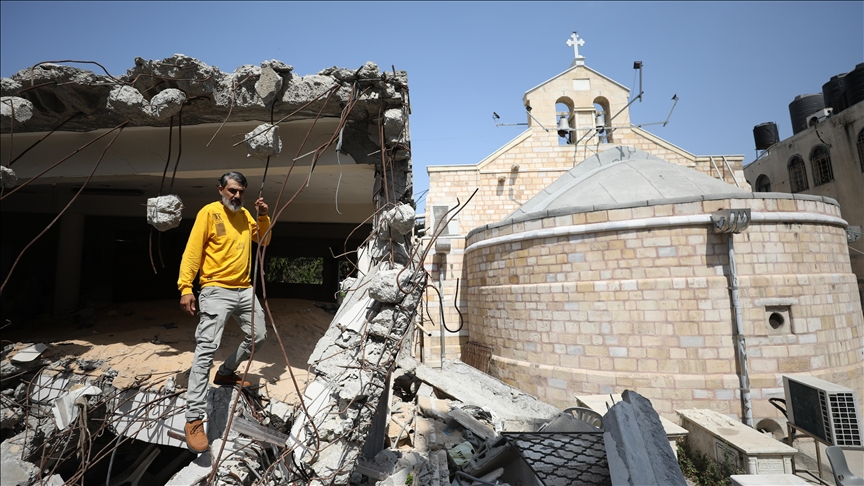
Christmas in Palestine this year arrives under the shadow of an ongoing genocide in Gaza. Two years into the Zionist mass murder of the Palestinian people, the death toll is staggering, in some reports, puts the number of Palestinians killed at over 600,000. The usually joyful streets of Bethlehem and Gaza are instead filled with grief and anger.
In a powerful show of solidarity, Palestinian Christian leaders in Bethlehem canceled all Christmas festivities, declaring there can be no celebration while Gaza’s people are being slaughtered “This has become a genocide with 1.7 million people displaced,” lamented Rev. Munther Isaac of Bethlehem’s Christmas Church.
Indeed, there are no twinkling lights or public Christmas trees in Manger Square this year. The traditional Christmas spirit has been replaced by a sense of purpose among Palestinians of all faiths to resist the viciousness of Zionism. Civil society groups instead erected a makeshift Nativity scene from the rubble of bombed buildings, a somber reminder of Gaza’s suffering.
For centuries, Muslims and Christians lived as neighbors in the Holy Land, peacefully sharing holidays and traditions. Old-timers still recall how Muslim families in cities like Jaffa, Jerusalem, and Bethlehem would join Christian neighbors in stringing up Christmas lights, just as Christians would share sweets during Eid.
This harmony was no accident as it was rooted in Islamic principles of tolerance. The Prophet Muhammad (peace be upon him) himself urged Muslims to protect the People of the Book.
He famously stated: “Whoever wrongs a person protected by a covenant [a non-Muslim under Muslim rule]… I will be his prosecutor on the Day of Resurrection.” In 628 CE, the Prophet granted a Charter of Privileges to the monks of St. Catherine’s Monastery, promising that Christians living under Muslim rule would be defended and their churches respected. Muslim rulers largely upheld these teachings. When Caliph Umar entered Jerusalem in 637 CE, he refused to pray inside the Church of the Holy Sepulchre, fearing later Muslims might use it as a pretext to convert the church into a mosque.
That cherished legacy of coexistence has been violently disrupted by the Zionist project in Palestine. Today, the Christian community finds itself under the same brutal assault as the Muslim majority. Nowhere has this been more evident than in Gaza. ‘Israel’s’ bombardment has not even spared Gaza’s churches.
In October 2023, Gaza’s historic Church of Saint Porphyrius (the city’s oldest church, dating to the 5th century) was bombed by a Zionist airstrike, collapsing an adjacent hall crowded with hundreds of Palestinian civilians who had sought shelter there. The blast tore through the Orthodox church compound and killed at least 18 people, Christians and Muslims alike, in what church leaders condemned as a “barbaric and unjustifiable act.” This was no isolated incident, ‘Israel’ has repeatedly bombed religious sites, including mosques and churches, even the United Nations labeled it a crime of “extermination” against Palestinians.
Just months later, in July 2025, ‘Israel’ bombed Gaza’s only Catholic church (the Holy Family Church), where dozens of displaced children and elderly were sheltering, killing at least three and wounding the parish priest.
In the West Bank and Jerusalem, too, Palestinian Christians face mounting dangers. Emboldened by ‘Israel’s’ far-right government, Jewish extremist settlers have targeted churches, clergy, and Christian cemeteries, aiming to drive Christians out. Clergymen report being spat on and harassed in Jerusalem’s Old City. “We feel [they] want us out of Jerusalem and they’re working on it unchecked,” Rev. Isaac warned, describing a climate of intimidation by radical settlers.
Meanwhile, Bethlehem, the cradle of Christmas, is strangled by walls and military checkpoints. The town’s Christian population has dwindled under occupation. This year, Bethlehem’s residents could not even find the heart to erect the traditional giant Christmas tree in Manger Square. “No one is in the mood to…decorate a Christmas tree,” one local said, as community groups canceled celebrations out of respect for Gaza’s suffering. Faced with this existential threat, Palestinian Muslims and Christians have drawn closer together than ever, forging an unbreakable bond of solidarity in their shared struggle.
During the anti-colonial Arab revolts of the 1930s, Palestinian rebels marched under flags emblazoned with both the cross and the crescent, symbolizing Christianity and Islam side by side. Christian Palestinians stood shoulder to shoulder with Muslim compatriots against British rule and Zionist militias. The first Palestinian intifada saw Muslim and Christian youths alike hurling stones at occupation tanks. Prominent resistance leaders have come from both faiths (from George Habash and Hanan Ashrawi to Sheikh Ahmad Yassin). This reflects a genuine mutual respect and a shared identity. As Rev. Raheb notes, “Jesus was from Bethlehem, after all. And this means a lot to us as Palestinians.” In other words, Palestinians see Jesus (peace be upon him), in his humanity and suffering, as one of their own.
The Quran and the Bible alike teach the sanctity of justice and the duty to resist tyranny. Muslims often invoke their faith in God’s promise of eventual justice, shouting “Allahu Akbar” (God is greatest) at protests or painting Quranic verses on the rubble of their homes.
Islamic tradition in particular emphasizes protecting Christian neighbors. The Prophet Muhammad’s (SAW) companions, when they conquered Jerusalem and other holy cities, upheld the safety of churches and synagogues. A famous hadith even has the Prophet declaring that any Muslim who harms a Christian or Jewish civilian under Muslim protection would face him (the Prophet) as an enemy on Judgement Day.
Palestinian Muslims today honor this legacy by seeing the Christian minority as their brothers and sisters in a single Palestinian nation. In turn, Palestinian Christians often say they could not imagine their land without Islam, church bells and the Muslim call to prayer have sounded in unison over their towns for generations. Together under Zionist bombardment, the two faiths have found strength in unity. As one Gazan Muslim put it after the church bombing, “Their church is our church now”. For us, Muslims, and our Christian neighbors, resistance is rooted in religious conviction. And the belief that oppression must be fought as a sacred duty and that liberation will ultimately come by the grace of God.
This ethos goes back to figures like Jesus of Nazareth (Prophet Isa, peace be upon him, in Islam), whom both Christians and Muslims revere. Jesus was born in this very land, in Bethlehem, under a foreign empire’s rule. As Rev. Isaac of Bethlehem reminds us, “We’ve always been under empires. We’ve always been displaced.”
When a people’s mosques are burned and churches bombed, when families are massacred and homes demolished, what keeps them going? It is faith. Faith in God, in each other, and in the righteousness of their cause. A popular saying among Palestinians is “God is with the oppressed, never with the oppressor.” On this somber Christmas, we urge our diaspora and allies worldwide to remember that faith is a form of resistance.
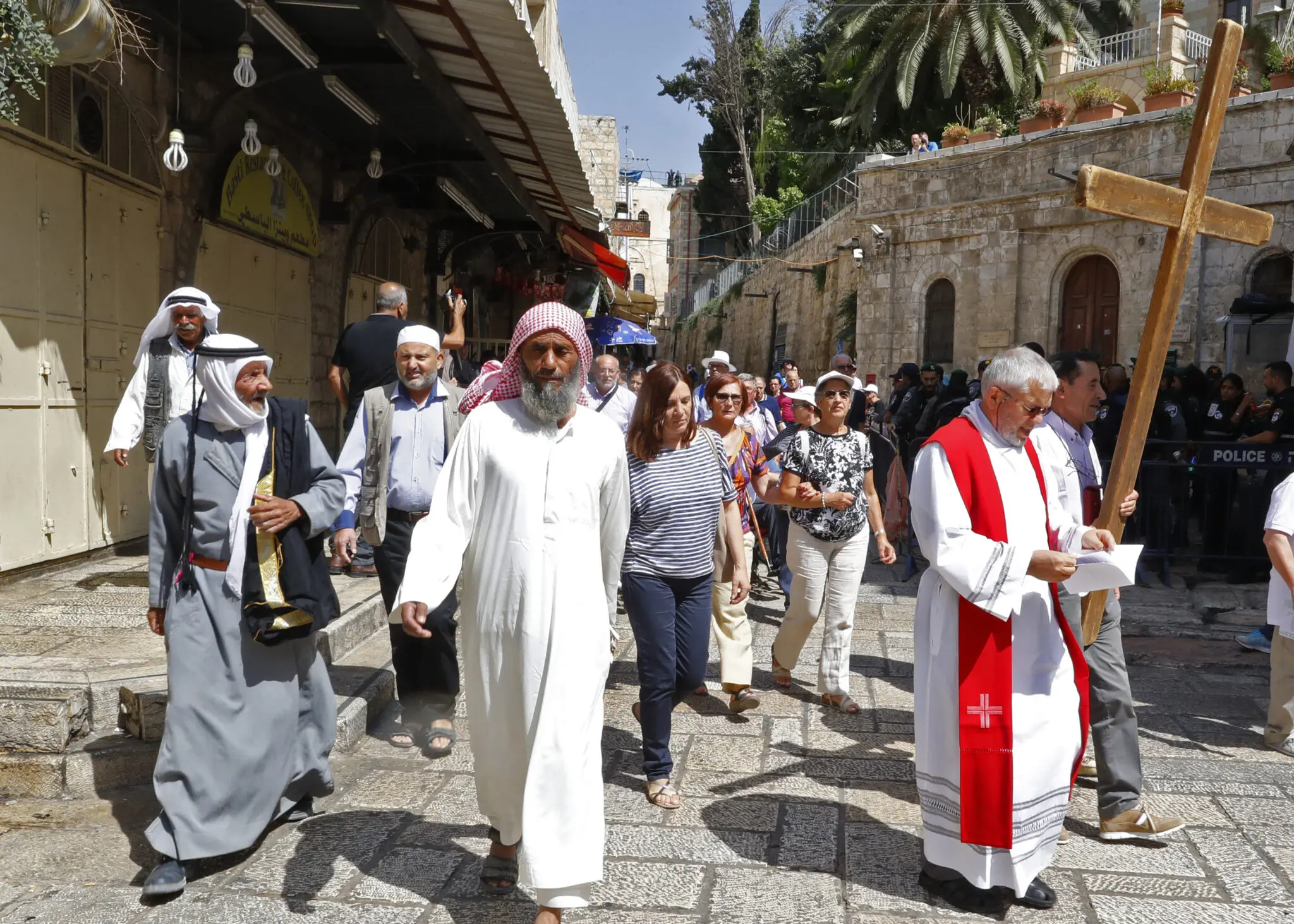
As a Muslim-led youth movement, we in the Palestine Diaspora Movement affirm that our Christian brothers and sisters are our partners in liberation.
We honor Jesus (Sayyidina Isa) as a guiding example of perseverance in the face of tyranny. And we honor the Prophet Muhammad’s (SAW) teachings by defending our Christian neighbors and following in his beloved footsteps.
The Zionist occupiers hope to fracture Palestinian society along these religious lines, to present themselves as protectors of Christians against Muslims or vice versa, but they have utterly failed. In Palestine, the reality is that churches and mosques are being destroyed by the Zionist enemy. We must perserve for our beloved Gaza! We must stay steadfast for our beloved Palestine!
And as Muslims, we believe in Allah’s promise that when we stand for His cause with sabr and steadfastness, He will stand with us, make our feet firm, and deliver victory over oppression.
SOURCES CITEDDíaz, W. (2023). Understanding the Connection Between Palestine and Christmas soundvision.com
Aftab, N. (2020). Caliph Umar Refused to Pray in The Church of The Holy Sepulchre…. New Age Islam newageislam.comSunan Abi Dawud 3052 abuaminaelias.comHatuqa, D. (2025). Israel kills three in Gaza Catholic church sheltering elderly, children. Al Jazeera aljazeera.comTharoor, I. (2023). Why Christmas is canceled in Bethlehem. The Washington Post washingtonpost.com
